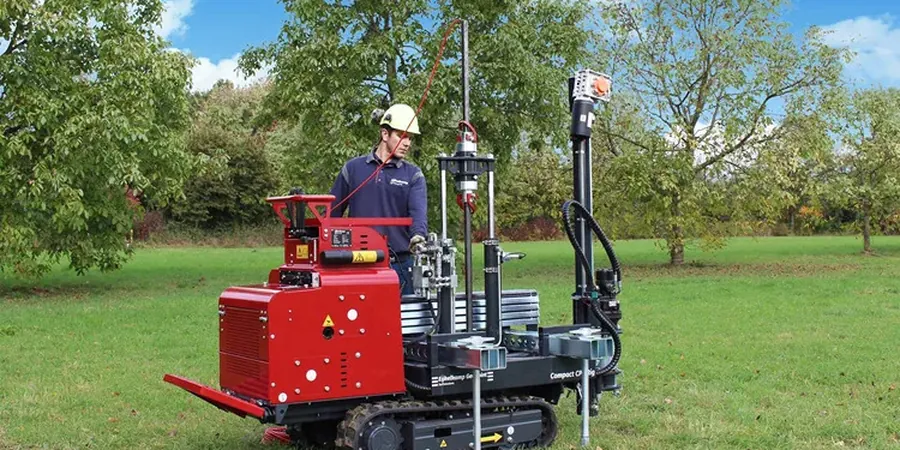
One of the most persistent – and expensive – mistakes made during site investigation in the Dundalk area is relying solely on borehole data without verifying stratigraphic continuity. The glacial and post-glacial deposits underlying the town are notoriously variable; a thin, stiff clay layer identified in one borehole can pinch out entirely just five metres away, leaving a soft silt pocket undetected. This is precisely the scenario where a CPT (Cone Penetration Test) provides the resolution that traditional methods miss, delivering a near-continuous profile of tip resistance, sleeve friction, and dynamic pore pressure that exposes hidden soft zones before they become a foundation failure. Our team deploys 20-tonne penetrometer rigs calibrated to ASTM D5778-20, capable of pushing through dense sands and gravelly lenses down to refusal, so that structural engineers working on the Castletown River floodplain or the Cooley Peninsula receive data they can trust for settlement analysis and pile design.
A CPT profile through Dundalk's estuarine sequence can reveal a 200 mm sand lens at eight metres depth that changes the entire consolidation model – and no rotary borehole would ever capture it.
Service characteristics in Dundalk
Critical ground factors in Dundalk
A pattern we observe repeatedly on Dundalk sites is the false confidence that comes from a handful of SPT N-values in glacial till. The till here contains erratic cobbles and boulders that can deflect a split-spoon sampler or produce misleading blow counts – a single N=18 reading tells you nothing about whether the surrounding matrix is dense sand or stiff clay. CPT soundings cut through this ambiguity by measuring the actual tip resistance profile, and the friction ratio helps separate granular till from cohesive matrix without relying on visual classification of disturbed cuttings. On a recent warehouse project near the M1 business park, a CPT profile identified a three-metre band of very loose silt at six metres depth that standard borehole logs had missed entirely; this discovery allowed the design team to extend piles through the weak zone before construction, avoiding differential settlement that would have cracked the slab within two years. When groundwater is perched within the upper weathered till – a common condition along the Dundalk Ridge – the piezocone's pore pressure response during dissipation tests provides direct data on drainage characteristics that no laboratory test on a bag sample can replicate.
Our services
Our CPT programme in the Dundalk and northeast Leinster region is designed to integrate directly with the geotechnical design workflow. Each sounding produces a digital data file that can be imported into software such as CPeT-IT, gINT, or PLAXIS for immediate interpretation, and we provide processed reports within 48 hours of field completion. The two core service configurations below cover the typical demands of residential, commercial, and infrastructure projects on the local glacial and estuarine soils.
Standard piezocone profiling with dissipation testing
A continuous CPTu sounding recording qc, fs, and u2 with dissipation tests at selected depths – typically at the base of soft clay layers and at proposed pile toe elevations. This configuration supplies the parameters needed for undrained shear strength (Su) estimation via Nkt factor, constrained modulus (M) for settlement calculations, and Soil Behaviour Type classification per Robertson charts. On Dundalk Bay margin sites, we routinely add extra dissipation stops where thin sand partings are detected, so that the consolidation coefficient (cv) can be derived directly from the measured t50 value rather than estimated from index tests on disturbed samples.
CPT-based liquefaction assessment package
For projects requiring seismic evaluation under Eurocode 8, we extend the standard CPT programme with closely spaced soundings and dedicated pore pressure ratio analysis. Using the NCEER/NSF procedure updated by Youd and Idriss (2001), we calculate the cyclic resistance ratio (CRR) directly from normalised tip resistance and friction ratio, avoiding the uncertainties of SPT-to-CPT correlations. This is particularly relevant for the loose saturated sands found in the Quaternary deposits near the Castletown estuary, where a design earthquake of magnitude 5.0–5.5 could trigger localised liquefaction. The output includes factor of safety versus depth plots and post-liquefaction settlement estimates for direct use by the structural engineer.
Frequently asked questions
What depth can a CPT rig reach in Dundalk's ground conditions?
In the soft to firm alluvial clays and silts typical of the Dundalk Bay lowlands, our 20-tonne penetrometer routinely reaches 25 to 30 metres before encountering refusal. In the lodgement till areas north and west of the town centre, refusal depths are more variable – generally between 8 and 18 metres depending on cobble content and density. We pre-auger through made ground or fill layers up to 2 metres when necessary to protect the cone and ensure vertical alignment.
How much does a CPT test cost in Dundalk?
A single CPT sounding in the Dundalk area typically falls in the range of €150 to €210, depending on depth achieved, number of dissipation tests requested, and site accessibility. Mobilisation is quoted separately and varies with distance from our nearest deployment base. For multi-sounding programmes on a single site, the per-sounding rate reduces. We provide fixed-price quotations after reviewing the site location and anticipated ground conditions.
Can CPT replace boreholes entirely for foundation design?
CPT provides superior continuous profiling and in-situ measurement of soil behaviour, but it does not recover physical samples for laboratory testing. For projects where index testing (Atterberg limits, particle size distribution) or strength testing (triaxial, oedometer) is required for final design parameters, we recommend a combined approach: CPT soundings to establish the stratigraphic framework and identify critical layers, supplemented by targeted boreholes or test pits at locations where sampling is necessary. This hybrid strategy typically reduces the total number of boreholes by 40 to 60 percent while improving the overall quality of the ground model.
What is the difference between SPT and CPT – and which one should I specify?
SPT (Standard Penetration Test) recovers a disturbed sample and provides a blow count (N-value) at discrete 1.5-metre intervals within a borehole. CPT pushes an instrumented cone continuously and records tip resistance, sleeve friction, and pore pressure at 10-millimetre intervals without recovering a sample. For sites on Dundalk's estuarine silts where thin drainage layers control settlement behaviour, CPT is the superior choice because it captures centimetre-scale stratigraphic detail. For sites where visual soil description and laboratory classification are contractually required, SPT or a combination of both methods is appropriate.
How quickly can you deliver CPT results after testing?
Raw data plots showing qc, fs, u2, and friction ratio versus depth are available within 24 hours of field completion via secure download. The interpreted report – including Soil Behaviour Type classification, derived geotechnical parameters (undrained shear strength, constrained modulus, relative density), and liquefaction analysis if requested – is delivered within 48 hours. For time-sensitive projects, we can provide preliminary interpretation over the phone on the same day as testing.