Ground improvement in Dundalk addresses the engineering challenges posed by the region's soft alluvial clays and compressible estuarine deposits, which frequently underlie local development sites. Compliance with Irish Standard I.S. EN 1997-1:2004 (Eurocode 7) and guidance from Engineers Ireland drives the need for rigorous site investigation and tailored treatment strategies. For cohesive soils requiring load transfer and drainage, [stone column design](stone-columns) provides a reliable solution, while [vibrocompaction design](vibrocompaction) is applied to densify loose granular fills often encountered in the area's industrial and port zones.
These techniques are critical for warehouse foundations along the Castletown River, residential schemes on reclaimed bogland, and infrastructure upgrades where settlement control is paramount. Integrating [stone column design](stone-columns) with preloading or staged construction ensures long-term performance on sensitive substrates. By selecting a method calibrated to Dundalk’s post-glacial stratigraphy, developers mitigate differential settlement and achieve bearing capacity compliance efficiently.
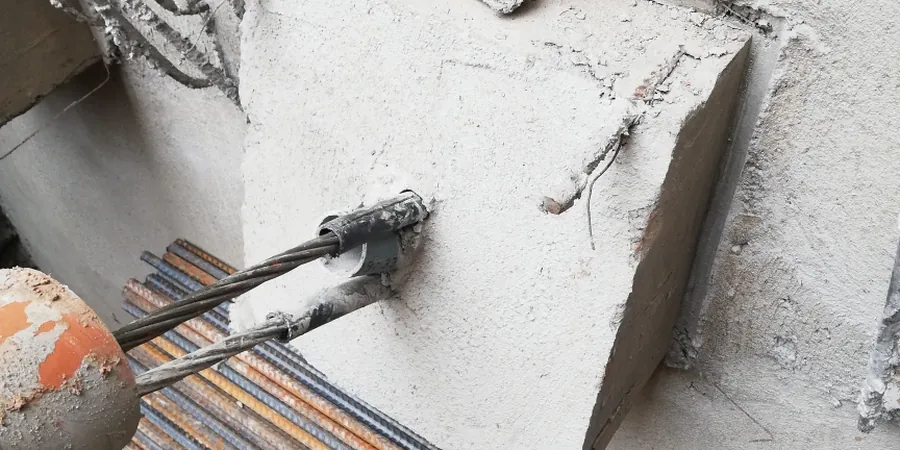
An anchor is not a passive nail. It is a pre-loaded tendon whose serviceability depends entirely on the grout-ground interface within the bond length, and in Dundalk's varved clays that interface demands careful flush drilling.
Service characteristics in Dundalk
Critical ground factors in Dundalk
We saw a case at a 14-metre excavation for a mixed-use block near the Inner Relief Road where a passive anchor system in silty clay crept 30 mm in two weeks, simply because the contractor underestimated the locked-in stress relaxation of the varved deposit. The outer leaf of a cavity wall in the adjacent building began to crack at the quoins. The root cause was not the anchor steel but the assumption of a rigid-perfectly-plastic bond stress distribution: the clay's time-dependent strain had shifted the load toward the proximal end of the bond zone, leaving the distal portion unstressed. We corrected it by extending the bond length into a deeper till unit and switching from passive to active regroutable anchors, then verified the new bond stress with a sacrificial investigation anchor tested to failure, reaching a creep rate below 1 mm per log cycle under 1.3 times the working load.
Our services
Anchor design in Dundalk moves between straightforward temporary tiebacks for open-cut excavations and permanent, fully grouted anchors for quay walls and flood defense structures. The two main service lines we deliver are:
Active Anchor Design and Stressing
We calculate the lock-off load to offset relaxation in Dundalk's normally consolidated clays, then execute investigation, suitability, and acceptance tests with a calibrated hydraulic jack and load cell. The stressing sequence follows the EN 1537 step-hold protocol, with creep monitored on a dial gauge to 0.01 mm precision. For permanent anchors in the Castletown River floodplain, we specify a 5-bar tendon with double corrosion protection and a minimum grout cover of 10 mm.
Passive Anchor and Soil Nail Systems
In cuts through the stony lodgement till of the Cooley foothills, we design passive grouted bars that mobilize resistance through shear along the full length without a defined free length. The pattern is typically 1.5 m × 1.5 m on a grid, with a 100 mm shotcrete facing reinforced by welded wire mesh. Installation is top-down with an initial 1.5 m unsupported cut, followed by nail drilling, grouting, and facing before the next lift.
Frequently asked questions
What is the difference between active and passive anchors for a Dundalk basement excavation?
Active anchors are tensioned to a lock-off load immediately after grout cure, which applies a pre-compression to the ground mass and limits lateral wall movement to a few millimetres. Passive anchors, often called soil nails, rely on ground deformation to generate force; they are not tensioned. In Dundalk's soft alluvial silts, active anchors are usually required for permanent works because they control settlement of adjacent buildings, while passive nails work well in the stiffer till on the north side of town.
How long does an anchor test take under EN 1537?
An investigation test to 1.5 times the service load, with load-hold increments of 5 to 15 minutes each, takes about 3 to 4 hours per anchor, depending on the number of load steps. Suitability tests are shorter, around 90 minutes. The critical measurement is creep rate: for a 5-metre bond in Dundalk's varved clay, we target less than 1 mm per log cycle of time at the maximum test load.
What is the typical cost range for an anchored retaining wall in Dundalk?
For a typical 3-metre-high basement wall with a single row of active anchors at 1.8-metre spacing, the anchor design, supply, installation, and testing work usually falls between €1,080 and €3,060 per anchor, depending on access, tendon length, and whether the anchor is temporary or permanent with double corrosion protection.
Can anchors be installed in the water-bearing gravels found near the Castletown River?
Yes, but the drilling method must switch to cased, water-flushed rotary drilling to prevent hole collapse. The grout injection uses a post-grouting tube system where the primary grout is followed 12 hours later by a secondary injection at 2 to 5 bar to fill any voids and improve the bond. We confirm the bond zone integrity with a water-pressure test in the drill hole before tendon placement.