We still see projects around Dundalk where the structural design assumes competent ground, only to hit compressible estuarine clays at 3 metres. The result is always the same: unexpected settlement, cracked slabs, and costly remedial work that could have been avoided. Stone column design is not a commodity item you tack on after planning. It requires a clear understanding of the site-specific stratigraphy, from the Carlingford Lough silts to the glacial tills that underpin the Cooley Peninsula. Our team integrates CPT testing to map the soft zones before a single column is installed, and we cross-check with triaxial testing to confirm the strength gain achieved after treatment. For sites with variable fill, we often combine columns with vibrocompaction to densify the upper granular layers before placing the foundation load. The payback is immediate: a uniform bearing stratum that eliminates the differential settlement risk and lets you proceed with a conventional raft or pad footing instead of deep piles.
A well-designed stone column grid can increase the composite ground modulus threefold over untreated estuarine clays, turning a marginal site into buildable land.
Service characteristics in Dundalk
Critical ground factors in Dundalk
IS EN 1997-1 requires a ground investigation report that adequately characterises the ground model before any geotechnical design begins. In Dundalk, the risk of skipping this step is concentrated in the 2–5 metre band where estuarine clays alternate with peat lenses and loose silty sands. That band is notorious for producing differential settlement when loaded unevenly. A stone column design that ignores lateral variability in the soft layer can leave unimproved pockets that settle independently, cracking the slab along column boundaries. The second risk is bulging failure: if the surrounding clay has an undrained shear strength below 15 kPa, the column may bulge excessively at shallow depth before transferring load to the toe. We mitigate this by specifying a minimum column length that reaches into the stiffer glacial till, confirmed by CPT refusal, and by limiting the area replacement ratio to values validated against the actual Cu profile from the site investigation.
Our services
Our stone column design package for Dundalk projects includes the full sequence from site characterisation through installation oversight to post-treatment verification. Each phase is documented to the standard required by the local authority and the design certifier.
Ground investigation for column design
CPT profiling and rotary boreholes to define the soft layer thickness and undrained shear strength profile across the building footprint. We target the Castletown alluvium and map the till interface.
Column layout and specification
Calculation of area replacement ratio, column spacing, and depth based on settlement tolerance and bearing capacity requirements. Drawings prepared for the installer.
Installation supervision and QA
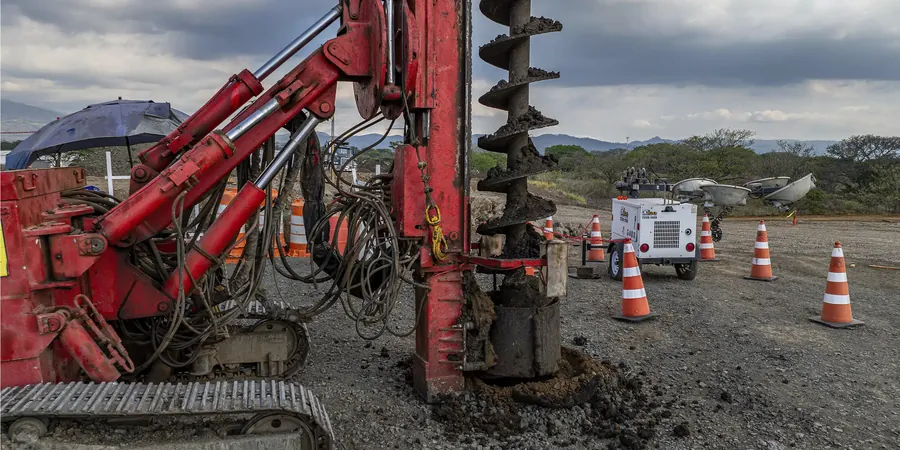
Full-time supervision during vibroflot installation, recording amperage, depth, and gravel consumption per column. Daily reports and as-built records.
Post-improvement verification testing
CPT after treatment to confirm composite strength, plus zone load tests where required by the spec. We deliver a final report that certifies the improvement meets the design intent.
Frequently asked questions
What does stone column design cost for a Dundalk site?
For a typical light industrial building footprint in this area, the design package including ground investigation review, column layout calculations, and installation specification runs between €1,400 and €4,260, depending on the number of CPT locations and the complexity of the loading. This is the design cost only; installation is priced separately by the ground treatment contractor.
How do stone columns compare to piling for soft ground in Dundalk?
Stone columns improve the ground so you can use a shallow foundation, which often eliminates the need for a suspended slab and grade beams. On sites where the soft layer is less than 12 metres deep and the loads are moderate, columns typically reduce the foundation cost by 30 to 50 percent compared to a full piled solution. The trade-off is that columns require a stable working platform and generate vibration during installation, which must be assessed for nearby structures.
What verification is required after the columns are installed?
The standard verification suite includes CPT probing between columns to confirm the composite strength has reached the design target. For larger projects we also specify zone load tests or plate load tests on a sample of columns. All results are documented in a verification report that the design certifier reviews before the foundation pour can proceed.