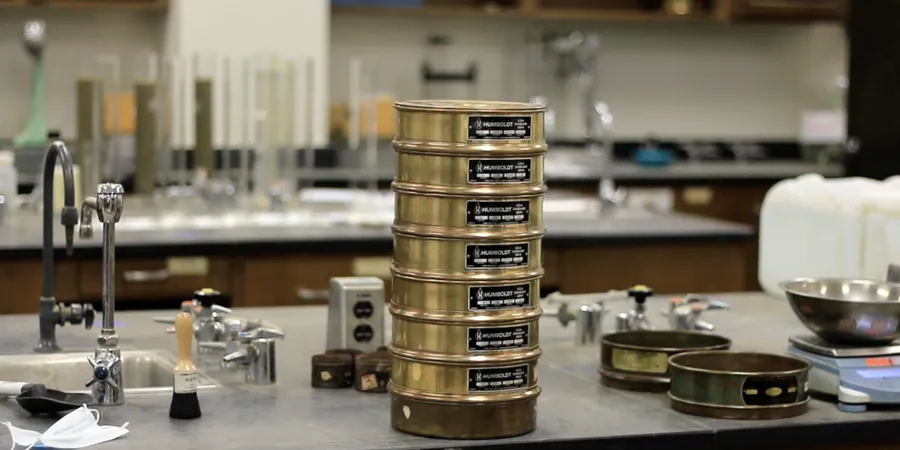
The glacial till and alluvial silts around Dundalk Bay don't forgive guesswork. You're dealing with a landscape shaped by the last ice age, where a stiff grey boulder clay can shift to soft lacustrine silt within 20 metres horizontally. I've seen pad foundations over-designed by 30% because the spec assumed a well-graded gravel that wasn't actually there. A proper grain size analysis, combining mechanical sieving for the coarse fraction and a hydrometer for fines passing the 75-micron sieve, pins down the real gradation curve. This single test determines permeability, frost susceptibility, and whether your Dundalk site needs imported fill or can reuse excavated material. For road subgrades on the N52 corridor, we often pair this with a CBR test to correlate gradation with bearing capacity before placing the pavement layers.
A gradation curve isn't just a lab report — it's the first honest conversation you'll have with the ground about drainage, compaction, and long-term settlement.
Service characteristics in Dundalk
Critical ground factors in Dundalk
A warehouse project near the Marshes in Dundalk taught a hard lesson. The geotech spec called for a free-draining granular blanket beneath the floor slab, but the borrow pit material hadn't been tested beyond a visual classification. We ran a full grain size analysis and found 28% passing the 75-micron sieve — far above the 12% limit for drainage. The contractor had already stockpiled 800 tonnes. They ended up blending it with crushed limestone at a 40:60 ratio to meet spec, costing two weeks and a five-figure sum. That's the risk in this town: the glacial deposits are heterogeneous, and what looks like sandy gravel in an excavator bucket can carry enough silt to clog a drainage layer within two winter seasons. A sieve and hydrometer test costs a few hundred euro and prevents a six-figure remediation later.
Our services
Every grain size analysis we deliver in Dundalk comes with the coefficients you actually need for design — not just a curve on a graph. Here's what the package includes:
Combined Sieve + Hydrometer (Full Gradation)
Complete particle size distribution from 75 mm gravel down to 2-micron clay, with D10, D30, D60, Cu and Cc calculated for USCS classification.
Wash Sieve Analysis (Fines Content Only)
Rapid determination of material passing the 75-micron sieve using wet sieving per ASTM D1140. Ideal for quality control on imported granular fill.
Carbonate Content Pre-Treatment
Acid digestion check on calcareous Dundalk till samples to prevent cementation bias in hydrometer readings.
Gradation vs. Drainage Assessment
We interpret the curve against Terzaghi filter criteria and SR 21 drainage guidelines so you know whether the material drains or retains water.
Frequently asked questions
How much does a grain size analysis cost in Dundalk?
A combined sieve and hydrometer test typically runs between €90 and €150 per sample, depending on whether you need the full gradation curve or just the fines content. Volume pricing applies for five or more samples from the same site.
How long does the hydrometer test take?
The sedimentation phase requires readings at intervals over 24 hours minimum, sometimes extending to 48 hours for very fine clays. We usually deliver the full report within three working days from sample receipt.
Can you test samples with gravel larger than 75 mm?
Yes. We follow ASTM D6913 with a field-split procedure: the plus-75mm fraction is measured and weighed separately, then the minus-75mm portion goes through the standard sieve stack. The final curve combines both fractions proportionally.
What's the difference between a sieve analysis and a hydrometer?
The sieve analysis handles particles retained on the 75-micron sieve — gravel and sand. The hydrometer measures the sedimentation rate of silt and clay particles suspended in water, giving you the distribution below 75 microns down to about 2 microns. Without the hydrometer, you're blind to the fines that control plasticity, permeability, and frost behaviour in Dundalk's glacial soils.