A recent warehouse extension near the Dundalk Western Bypass ran into serious trouble during earthworks. The fill was being placed in 300 mm lifts and compacted with a heavy roller, but post-construction tests showed settlement within three months. The issue was not the compactive effort but the moisture conditioning. A laboratory Proctor test on the site soil, a sandy silty till typical of the area, revealed the optimum moisture content was 4 percent higher than what the crew was using. Adjusting the water trucks solved the problem within a day. This is the practical value of the Proctor test. It defines the exact relationship between moisture and dry density, and without it, even well-graded granular fill can underperform. In Dundalk, where glacial deposits dominate the subgrade and weather fronts roll in from the Irish Sea, this test is not optional. It is the basis for every compaction specification on road projects and building platforms across County Louth.
On Dundalk's moisture-sensitive glacial tills, a 2 percent deviation from optimum moisture can reduce field density by over 8 percent.
Service characteristics in Dundalk
Critical ground factors in Dundalk
The most frequent mistake on Dundalk sites is running a Standard Proctor when the specification demands Modified. A contractor unwittingly targets a lower density, passes the field density test, but the fill is undercompacted for the design load. We see this on industrial slab-on-grade projects where forklift traffic induces differential settlement within the first year. Another local risk is testing a sample that does not represent the full particle size distribution. Dundalk tills often contain cobbles up to 100 mm. If these are scalped out incorrectly, the lab test overestimates the fines content and gives an unrealistically low maximum dry density. The result is an impossible target for the site team. The third risk is moisture control. The optimum moisture content from the lab must be achieved on site, but Dundalk's frequent rainfall can push the fill wet of optimum within hours. Working wet of optimum on these silty tills rapidly increases pore pressure and reduces shear strength. The Proctor curve's shape matters: a steep curve means the soil is unforgiving, and the window for compaction is narrow.
Our services
The Proctor test is part of a broader earthworks control package. The two services below are the most frequently paired with compaction testing on Dundalk projects.
Standard Proctor (Light Compaction)
For residential footpaths, garden areas, and lightly loaded fill behind retaining walls. Uses BS 1377-4 light compaction method. Test includes the full moisture-density curve, optimum moisture content, and maximum dry density. Typical turnaround is 48 hours from sample receipt.
Modified Proctor (Heavy Compaction)
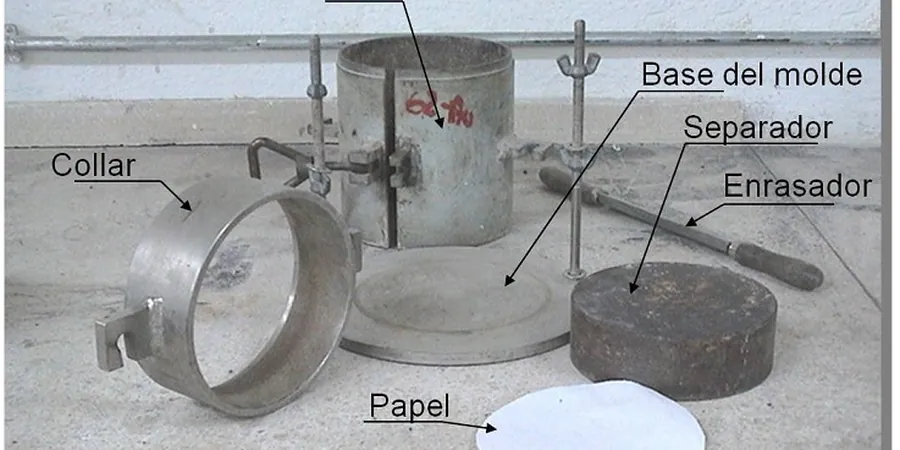
Required for structural fill under foundations, road sub-base, and heavy industrial yards. Replicates the energy of modern vibratory rollers per BS 1377-4 heavy compaction or ASTM D1557. Includes particle density check and air voids lines. Suitable for Dundalk's dense glacial till when high stiffness is specified.
Frequently asked questions
What is the price of a Proctor test in Dundalk?
The cost for a single Proctor compaction test (Standard or Modified) in Dundalk ranges from €100 to €190, depending on the number of compaction points required and whether the sample needs additional preparation such as scalping of oversize particles. A full curve with five points is at the higher end of this range.
Which Proctor standard applies to road works on the M1 Dundalk Western Bypass?
Road works under TII (Transport Infrastructure Ireland) jurisdiction typically require the Modified Proctor test per IS EN 13286-2 and the NRA Series 600 specification. The heavier compaction effort is mandatory for sub-base and capping layers to achieve the required stiffness modulus for heavy traffic loading.
How much material is needed for a Proctor test?
A minimum of 25 kg of disturbed bulk sample is needed for a reliable Proctor test on Dundalk's glacial till. If the soil contains particles larger than 20 mm, the sample mass increases to 40 kg or more to allow proper scalping and representative sub-sampling of the fine fraction.
Can the Proctor test be done on site in Dundalk?
No. The Proctor test is a laboratory procedure requiring controlled drying, precise moisture addition, and a standardised mechanical rammer. It cannot be replicated with field equipment. The lab result is then used on site to calibrate a nuclear density gauge or perform a sand replacement test for field density verification.