Dundalk’s growth from a medieval stronghold to a modern logistics hub straddling the Castletown River means its industrial estates and housing schemes now sit on a challenging patchwork of glacial tills, alluvium, and occasional soft lacustrine clays. Anyone breaking ground near the Inner Relief Road or out by the IDA Business Park quickly discovers that assumptions based on a few trial pits rarely hold. The Standard Penetration Test remains the most cost-effective way to build a continuous strength profile through these variable deposits. We run our SPT rigs with automatic trip hammers calibrated to IS EN ISO 22476-3:2005, and every sample jar comes straight to our ISO 17025-accredited lab for logging, giving engineers the N-values and split-spoon descriptions they need to size footings or check liquefaction potential under Eurocode 8. In parts of town where made ground overlies the till, combining SPT data with a CPT profile often clarifies the transition between fill and natural strata without the ambiguity that a single method can leave.
A refusal in Dundalk till is rarely the full story; the split-spoon sample tells you whether you hit a boulder or the real bearing stratum.
Service characteristics in Dundalk
Critical ground factors in Dundalk
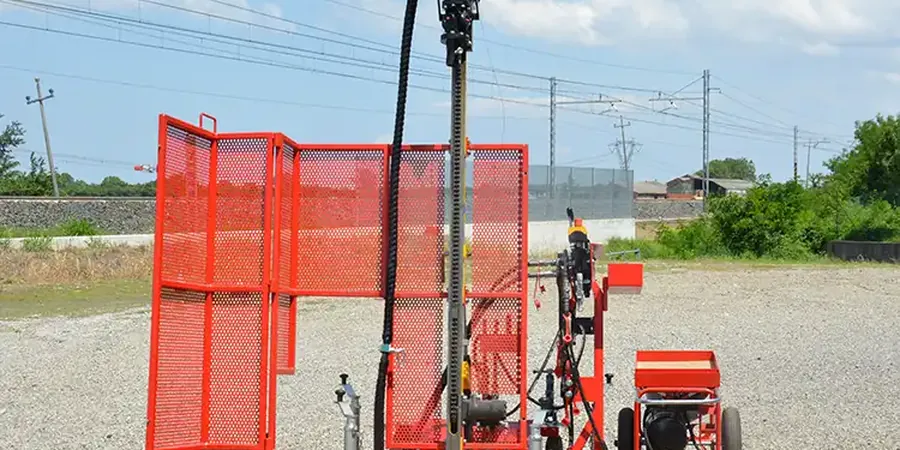
Our SPT setup in Dundalk uses a track-mounted rig with an automatic trip hammer and a 140 lb drive weight falling exactly 30 inches, in full compliance with the energy calibration requirements of IS EN ISO 22476-3. The rig is compact enough to work inside existing warehouse units on the Coe’s Road when clients need to check floor slab support, yet it has the power to push through the stony upper till that blunts lighter equipment. In the Quay Street area, where saturated alluvial silts sit above the till, we routinely measure groundwater during drilling and record the SPT N-values every 1.5 metres; those numbers feed directly into the simplified liquefaction screening procedure of EN 1998-5. Contractors who skip this step risk discovering after a wet winter that a perfectly good pad foundation has begun to settle differentially, an outcome that a day of properly instrumented SPT work would have flagged from the start.
Our services
Beyond the SPT rig, we provide the laboratory and engineering support that turns raw blow counts into a defensible ground model for your Dundalk project.
SPT with Laboratory Index Testing
Every split-spoon sample goes through particle-size analysis, Atterberg limits, and moisture-content determination in our ISO 17025 lab so that the N-value is always paired with a full soil description.
Liquefaction Screening for Dundalk Alluvium
Using SPT N-values corrected for energy and overburden, we apply the EN 1998-5 cyclic-stress method to assess liquefaction risk beneath industrial buildings and riverside developments.
Frequently asked questions
How much does an SPT investigation typically cost for a single house site in Dundalk?
For a standard residential plot around town, budget between €460 and €660 for mobilisation, two to three boreholes to 6–8 metres, and a factual report with N-value logs. The final figure depends on access, depth required, and how many samples need laboratory classification.
Can the SPT identify the risk of liquefaction on the Castletown floodplain?
Yes, it is the reference method. By correcting the field N-values for overburden pressure, hammer energy, and fines content, we generate the cyclic resistance ratio required by EN 1998-5. The silty alluvium near the river often falls into the borderline category, so the SPT data is essential for deciding whether ground improvement is needed.
What is the difference between SPT and CPT for a Dundalk industrial site?
SPT recovers a physical soil sample, which lets us see and test the actual material — critical when gravel lenses or cobbles are suspected. CPT gives a near-continuous profile of tip resistance and pore pressure, which is excellent for soft clays. On a mixed-profile site like many in Dundalk, running both methods on a few locations gives the most solid picture.
How quickly can we get the SPT logs after drilling?
Field logs are available the same day. If laboratory classification is needed, we typically deliver the full factual report within five to seven working days, faster if the project schedule demands it.