Dundalk’s growth from a medieval stronghold to a major industrial port has left a patchwork of ground conditions beneath the surface. The redevelopment of the old GNR railway lands and the expansion of the IDA business parks often encounter glacial tills mixed with alluvial silts from the Castletown River. When a contractor breaks ground near Finnabair or the DKIT campus, the first question from the design team is usually about soil consistency. Atterberg limits give a direct, repeatable answer. We test the liquid and plastic limits of fine-grained soils to classify the material and predict how it will behave under changes in moisture—something this town, with 1,000 mm of annual rainfall, has to take seriously. A quick test pit investigation combined with limits testing often saves weeks of redesign later.
A plasticity index over 30 in Dundalk’s alluvial clays almost always means you will need ground improvement before placing structural fill.
Service characteristics in Dundalk
Critical ground factors in Dundalk
One thing that catches engineers off guard in Dundalk is how a perfectly compacted clay subgrade can fail a year later because the plasticity was misclassified. We have seen site investigation reports that labelled everything as 'boulder clay' without running a single Atterberg test. That generic label hides a lot of variation: some of the local lodgement tills have a PI below 12 and drain reasonably well, while the laminated clays further south towards the estuary can hit a PI of 40. If you treat them the same, the pavement design will be wrong. The real risk is differential heave and shrinkage, especially under lightly loaded structures like cycle paths and single-storey extensions. Knowing the shrinkage limit and the liquidity index lets you design the capping layer correctly from day one.
Our services
Our Dundalk laboratory provides a full suite of classification tests for fine-grained soils. We can work from bag samples you drop off or from materials we recover during a site investigation.
Liquid & Plastic Limit Testing
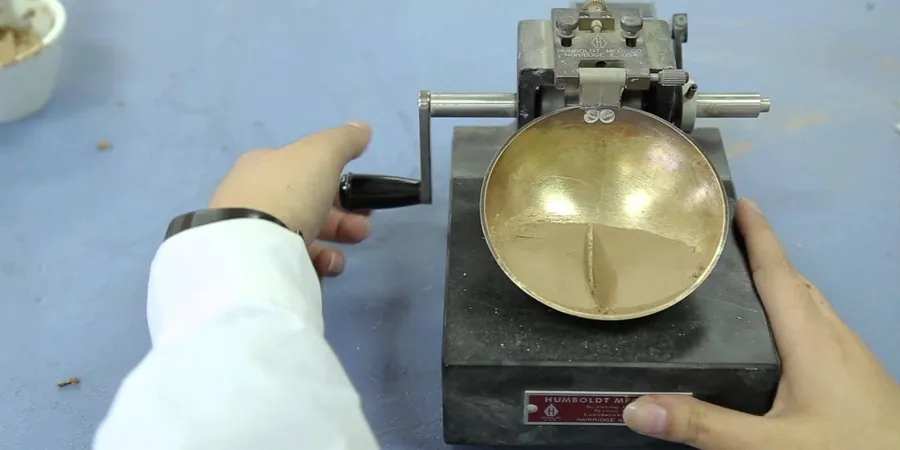
Standard Casagrande cup and cone penetrometer methods for determining the liquid limit, plus the hand-rolling method for plastic limit, all under BS 1377-2.
Shrinkage Limit Determination
Measurement of the shrinkage limit using the mercury displacement or wax method, critical for assessing volume change potential in expansive Dundalk clays.
Moisture Content & Density Correlation
Natural water content testing alongside Atterberg limits to calculate the Liquidity Index, giving you immediate insight into the in-situ consistency of the soil.
Frequently asked questions
How much does Atterberg limits testing cost in Dundalk?
For a standard set of liquid limit and plastic limit tests on a single sample, the cost ranges from €60 to €90, depending on whether you need the shrinkage limit or express turnaround included. Bulk pricing for multiple samples from the same site is available on request.
How long does it take to get results?
Standard turnaround is 3 to 5 working days from sample receipt. We can provide a 24-hour express service for an additional fee if the results are needed urgently for an ongoing earthworks operation in Dundalk.
What soil types need Atterberg limits testing?
Any fine-grained soil where more than 35% of the particles pass a 425 µm sieve should be tested. This covers the silts and clays common in Dundalk’s glacial till and estuarine deposits. Sands and gravels do not exhibit plasticity and are classified by grain size instead.
Can I drop off a bag sample for testing?
Yes. You can deliver a 500 g disturbed sample to our receiving office in the Dundalk area. Just make sure the bag is sealed to preserve the natural moisture content; we will oven-dry a portion to calculate the water content before running the limits.