Dundalk sits on a complex sequence of glacial tills and alluvial deposits left by the retreat of the last ice sheet, and anyone who has tried to open a trench near the Castletown River knows the ground can change completely in less than fifty metres. We often see firm stony lodgement till on the north side of town grading into softer, wetter material around the Blackrock lowlands, which means a standard pavement cross-section rarely works across an entire project.
Before we even begin the layer analysis, we tie the proposed formation strength back to actual California Bearing Ratio values measured on site, because relying on desk-study assumptions in this part of County Louth has a habit of coming back to haunt you during the first wet winter. When the subgrade is marginal, we frequently pair the pavement design with a CBR road assessment to confirm the soaked strength, and if the investigation reveals deeper soft spots we may recommend vibrocompaction to stabilise the formation before placing the capping layer.
A flexible pavement in Dundalk lives or dies by the drainage detail: get the sub-surface water away from the formation and the rest of the design holds together.
Service characteristics in Dundalk
We model the bound and unbound layers using linear-elastic multi-layer analysis calibrated to the traffic loading expected over the design life, normally twenty years for a local authority road or twenty-five for a strategic access route. The asphalt thickness is driven by the tensile strain at the bottom of the bituminous layer, while the granular sub-base depth is governed by the vertical compressive strain on top of the subgrade, both checked against the performance criteria in the Irish NRA Design Manual for Roads and Bridges. Where the natural ground is particularly sensitive to moisture, we specify a geogrid separator and a drainage blanket as part of the foundation improvement package, because a saturated sub-base in Dundalk loses stiffness faster than many engineers expect.
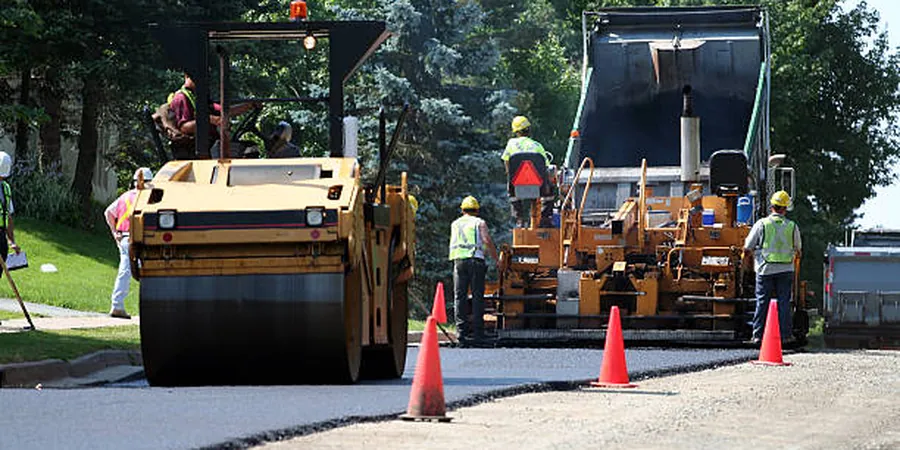
Critical ground factors in Dundalk
Dundalk’s expansion over the past thirty years has pushed new development onto agricultural land that was never intended to carry heavy axle loads, and some of those fields overlay thin peat pockets that barely register on a standard trial pit log. The real risk with flexible pavement design in this area is differential settlement caused by these compressible lenses: the carriageway might meet the roughness index on day one, but after three winters of repeated loading and high groundwater, you start seeing longitudinal cracking exactly where the subgrade transitions from till to organic silt.
We have also learned to watch for sulphate attack on the bound layers in parts of town where the groundwater picks up ions from the underlying Carboniferous limestone bedrock. Specifying a sulphate-resistant base course and ensuring the drainage system does not pond water against the pavement edge are small details that make an enormous difference to the long-term performance of a flexible pavement in Dundalk.
Our services
We deliver a design package that moves from site investigation straight through to a fully specified layer schedule, so the contractor receives something that can actually be built with local materials.
Subgrade investigation and CBR assessment
In-situ DCP and plate load testing correlated with laboratory soaked CBR on Shelby tube samples, giving you a defensible formation strength value for each pavement segment.
Traffic loading and design life analysis
Conversion of traffic counts into equivalent standard axle loads using the Irish NRA axle load equivalency factors, with sensitivity checks for growth rates up to 4 % per annum.
Multi-layer elastic pavement modelling
Bitumen-bound and unbound layers analysed in a linear-elastic framework to verify that tensile strain at the asphalt base and compressive strain at the subgrade surface stay within NRA fatigue and deformation criteria.
Foundation improvement and drainage specification
Design of geogrid-reinforced capping layers, edge drains, and filter material where the Dundalk subgrade is susceptible to softening or where perched groundwater is identified during the investigation.
Frequently asked questions
What makes flexible pavement design in Dundalk different from other Irish towns?
The glacial till that underlies much of the town is highly variable, with dense stony layers sitting next to soft silty pockets within the same road alignment. We also encounter peat lenses and high groundwater in the low-lying areas near the Castletown River and the coast, which forces us to account for much wider scatter in the formation CBR than you would expect on a typical Midlands scheme. The design almost always includes a site-specific soaked CBR campaign and careful attention to subsurface drainage.
How long does a flexible pavement design typically take from investigation to final layer schedule?
Most projects in Dundalk move from our first site visit to a draft layer schedule within three to four weeks. The site investigation and laboratory soaked CBR testing consume the bulk of that time, because we insist on conditioning the samples for four days as per BS 1377-4 before deriving the design CBR. Once the formation strength and traffic load are confirmed, the multi-layer analysis and the layer thickness optimisation are usually completed in under a week.
What is the typical cost range for a flexible pavement design service in Dundalk?
Depending on the length of the carriageway, the number of investigation points, and the complexity of the traffic analysis, our fees for a flexible pavement design in the Dundalk area usually fall between €1,660 and €4,700. A short access road with straightforward ground conditions sits at the lower end, while a longer industrial access with variable subgrade and full DMRB traffic modelling moves toward the upper end of that range.
Do you coordinate with the local authority road opening licence requirements in County Louth?
Yes, we are familiar with the Louth County Council requirements for road opening licences and Section 254 applications where the pavement design affects public roads. Our package can include the supporting technical documentation that the council normally requests, including the formation CBR justification and the design life statement referenced to the NRA DMRB.