A three-storey extension on the Castletown Road ran into trouble last spring. The desk study flagged a possible soft clay basin beneath the glacial till, and the structural engineer needed a reliable ground model before finalising the foundation design. The team ran a series of MASW lines across the site and measured a Vs30 of just 215 m/s, well into Eurocode 8 ground type D. That single number changed the seismic coefficient and the reinforcement schedule — and it came from a non-invasive surface wave survey that took less than a morning. In Dundalk, where the Quaternary geology jumps between stiff lodgement till and compressible lacustrine silts over distances of a few hundred metres, knowing the real shear wave velocity profile is the difference between a code-compliant design and an assumption that won't stand up to peer review. We often combine MASW with a few CPT soundings to tie the Vs profile to a direct tip resistance log when the client needs a full geotechnical model for taller structures.
In Dundalk, a Vs30 value can jump from 215 m/s to over 500 m/s in less than 300 metres — lateral variability is the rule, not the exception.
Service characteristics in Dundalk
Demonstration video
Critical ground factors in Dundalk
Dundalk sits at roughly 10 metres above sea level and its eastern edge is barely above the high tide mark. Combine that elevation with a groundwater table that often sits within 1.5 metres of the surface, and you have conditions where pore pressure softening can amplify ground motion during a distant earthquake. Ireland is a low-to-moderate seismicity region — the Irish National Annex to Eurocode 8 assigns a reference peak ground acceleration of 0.04 g to Dundalk — but the site amplification factor for a soft soil profile can multiply that by 1.6 or more. A building on ground type D experiences spectral accelerations equivalent to a structure on rock in a significantly higher seismic zone. Developers who skip the Vs30 measurement and default to ground type B are effectively under-designing the lateral load path. The 2013 Llŷn Peninsula earthquake, felt along the east coast, reminded engineers that shallow crustal events in the Irish Sea are real. For critical infrastructure — schools, healthcare, emergency response facilities — the TII and Department of Education now routinely ask for a site-specific shear wave velocity profile. MASW delivers it without the access constraints of borehole methods.
Our services
Our Dundalk-based geophysics programme covers the full chain from surface wave acquisition to seismic site classification. Each survey is designed around the specific target depth and the expected lateral variability of the site.
MASW 1D profiling and Vs30 determination
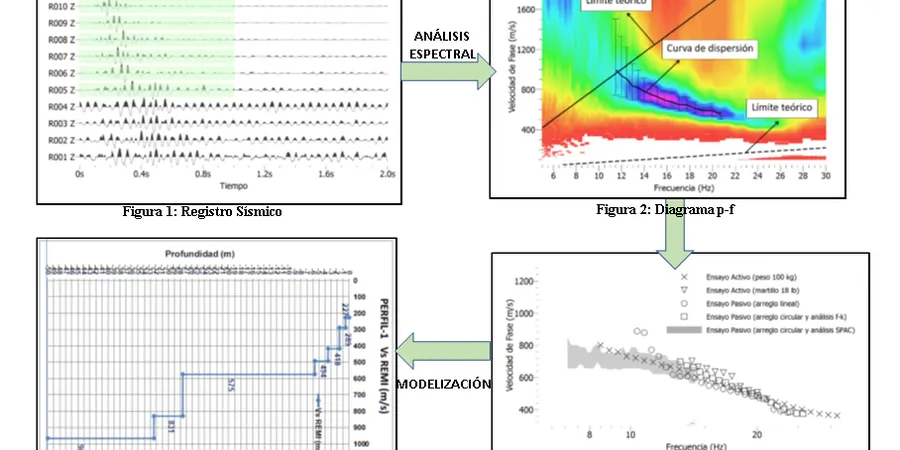
Active-source linear array acquisition with 24-channel seismograph for site classification to Eurocode 8 and TII ground investigation requirements. Deliverables include dispersion images, 1D Vs profiles, and a signed report with the computed Vs30 value.
2D MASW shear wave tomography
Roll-along acquisition with overlapping geophone spreads to build a continuous cross-section of Vs along a survey line. Useful for detecting lateral changes in stiffness across the boundary between till and alluvial deposits typical of the Dundalk area.
Combined Vs30 and ground investigation packages
Integrated surveys where MASW lines are calibrated against dynamic probing, SPT boreholes, or CPTu soundings on the same site. The correlation between Vs and penetration resistance refines the ground model and reduces uncertainty in liquefaction screening assessments.
Frequently asked questions
What is the cost of a MASW survey in Dundalk?
A typical MASW survey for site classification on a standard development plot in Dundalk falls between €1,540 and €2,470. The final figure depends on the number of array positions, the target depth, and whether 1D spot measurements or a 2D roll-along line is required. We provide a fixed-price quotation after reviewing the site location and the project brief.
How does MASW compare with downhole seismic testing?
MASW is non-invasive — no borehole required — which makes it faster and less costly on accessible greenfield sites. Downhole testing gives a more precise Vs log at a single point and works on congested urban plots where a 60-metre geophone spread cannot be laid out. In Dundalk we often recommend MASW for open sites and downhole or crosshole methods for tight urban infill projects where space is limited.
Which Eurocode 8 ground type applies to most of Dundalk?
There is no single answer — Dundalk's ground conditions vary sharply. Sites on the Cooley till north of town often classify as ground type B (Vs30 > 360 m/s), while the softer silts and alluvium near the Castletown River and the inner bay typically fall into ground type C or D (Vs30 between 180 and 360 m/s). A site-specific MASW survey is the only reliable way to determine the correct classification.
How long does a MASW survey take on site?
A single 1D MASW sounding with a 24-channel array takes about 30 to 45 minutes once the geophones are laid out. A 2D roll-along line covering 120 metres of survey length can be completed in half a day. We deliver the processed Vs profile and the Vs30 report within five working days of field acquisition.
Can MASW be used for liquefaction assessment in Ireland?
Yes. Although Ireland's seismic hazard is moderate, liquefaction screening is required for certain TII structures and for projects in areas with saturated loose sands. Vs-based liquefaction triggering procedures (Andrus & Stokoe, Youd & Idriss) are directly applicable, and the Vs30 from MASW feeds into the simplified procedure for estimating cyclic resistance ratios.