Dundalk’s industrial expansion from a medieval port town into a modern logistics hub along the M1 corridor has placed heavy demands on its underlying ground. Much of the town sits on deep sequences of soft alluvial and estuarine deposits laid down by the Castletown River and Dundalk Bay, where the water table often sits less than a metre below the surface. In our experience, these saturated silts and fine sands are exactly the materials that demand careful evaluation for cyclic mobility and flow failure potential. A proper soil liquefaction analysis here goes beyond a standard desk study—it requires site-specific investigation tied directly to the seismic hazard model for the northeast Leinster region. When we work on sites near the Inner Relief Road or the expanding business parks off the N52, we routinely combine downhole seismic methods with the MASW survey to build a solid shear-wave velocity profile, which feeds directly into the CSR-CRR calculations mandated by Eurocode 8.
Saturated silts and loose sands in Dundalk’s estuarine basin can lose 60% of their bearing capacity in less than 15 seconds under seismic loading—site-specific analysis is the only reliable safeguard.
Service characteristics in Dundalk
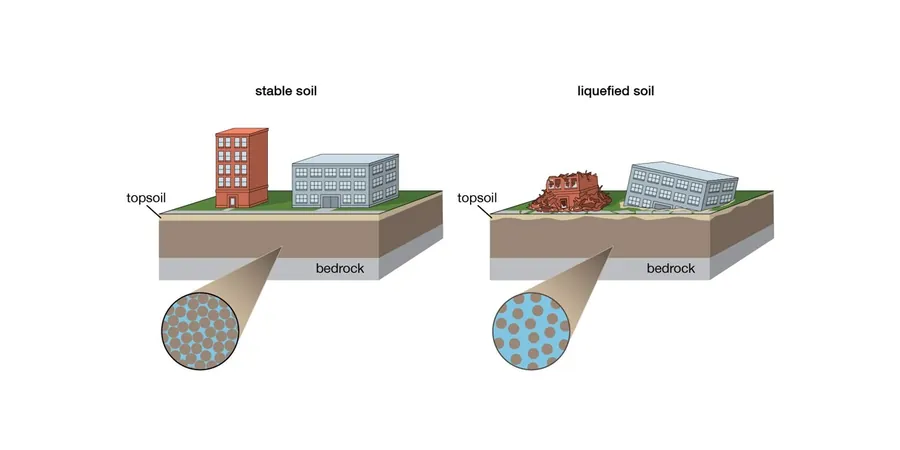
Critical ground factors in Dundalk
With a population approaching 43,000 and major infrastructure like the Dundalk Institute of Technology campus and the IDA Business Park continuing to expand, the exposure to ground failure risk grows with every new development. The last significant seismic event felt in County Louth was the 1984 Llŷn Peninsula earthquake, magnitude 5.4, which triggered localised sand boils in reclaimed marshland near the Quay area—a clear reminder that moderate, distant events can still destabilise Dundalk’s saturated ground. Omitting a soil liquefaction analysis on a project over 2,500 m² of footprint risks not just structural settlement but also lateral spreading toward open excavations or buried utilities, which we have seen require costly emergency shoring when the design ground model ignores the liquefiable layers.
Our services
We deliver Dundalk-focused geotechnical assessments that integrate the specific stratigraphy of the Castletown River basin. The soil liquefaction analysis is supported by targeted field investigation and laboratory programmes designed to isolate the most critical layers.
Site-Specific Liquefaction Hazard Assessment
Full simplified-procedure evaluation using SPT or CPT data corrected for fines content and effective stress, delivering factor of safety profiles, LPI mapping, and post-liquefaction settlement estimates calibrated to the soft estuarine silts found across the Dundalk bay area.
Ground Improvement Feasibility for Liquefiable Soils
Option study covering vibrocompaction, stone columns, and deep soil mixing in Dundalk’s high-water-table conditions, with pre- and post-treatment verification testing to confirm that the design CSR threshold has been met beneath the proposed foundation footprint.
Frequently asked questions
Is Dundalk in a high-seismicity zone that would require a soil liquefaction analysis under Irish building regulations?
Dundalk is classified as a low-to-moderate seismicity area under Eurocode 8, with a reference peak ground acceleration of approximately 0.08g–0.12g for a 475-year return period. The Irish National Annex still requires a liquefaction assessment for any structure in consequence class CC2 or above when the site investigation identifies saturated, loose granular soils within the top 20 metres, which is a common scenario in the Castletown River basin.
How deep do you typically need to investigate for a reliable soil liquefaction analysis in Dundalk?
We normally extend the investigation to 20 metres below ground level as a baseline, but on sites near the river and bay with deep sequences of soft silts and interbedded sands, we frequently push boreholes to 25 metres to ensure we capture the full liquefiable profile and any underlying dense bearing layer.
What field tests do you use to gather data for the liquefaction assessment?
SPT with energy-calibrated hammer is the most common method because of the extensive empirical correlations available. On larger industrial projects we increasingly deploy CPTu as well, which gives a near-continuous profile of tip resistance and pore pressure, making it easier to detect thin drainage layers that influence the liquefaction response.
How much does a soil liquefaction analysis cost for a typical Dundalk commercial plot?
For a standard commercial development site in Dundalk, the analysis together with targeted field investigation and a Eurocode 7-compliant report typically falls between €2,240 and €4,350, depending on the number of boreholes, depth of investigation, and whether laboratory cyclic triaxial testing is required.
Can you recommend ground improvement techniques if the analysis shows high liquefaction potential?
Yes, based on the factor-of-safety profile and the site constraints we evaluate vibrocompaction, stone columns, or rigid inclusions. In Dundalk’s high-water-table environment we often favour stone columns because they provide drainage paths that help dissipate excess pore pressure while densifying the surrounding soil, addressing both the triggering and the consequence of liquefaction.