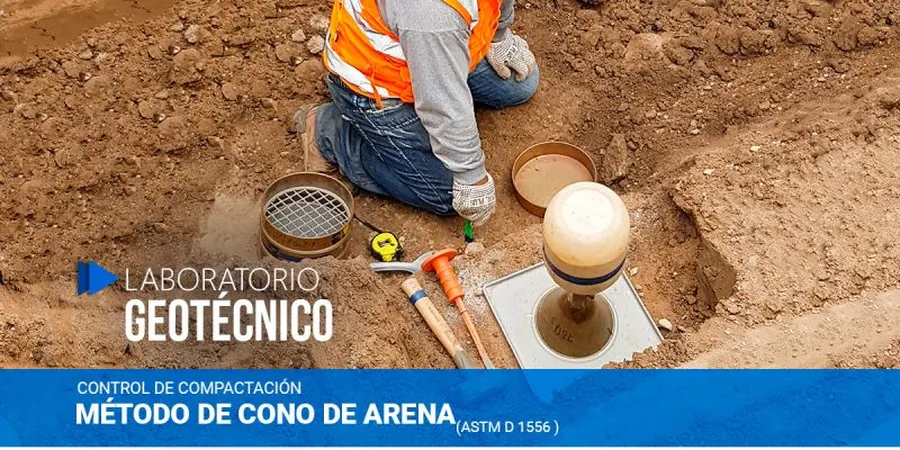
The glacial tills and alluvial silts beneath Dundalk present a compaction challenge that standard lab tests alone cannot resolve. With groundwater perched at shallow depths across the Castletown River floodplain and soft cohesive layers extending down to 15 metres in places, achieving 95% Modified Proctor density requires direct field verification. Our team deploys the sand cone apparatus per BS 1377-9:1990 and IS 2720 Part 28 to measure in-place wet density on active fill lifts, trench backfill around utilities, and granular subbases under industrial slabs. A single test pit in the wrong spot can miss low-density pockets that later translate into differential settlement. That is why we combine field density readings with Proctor curves from the same borrow source, giving the site engineer a reliable compaction ratio within hours of sampling.
One percentage point below spec on a 3-metre lift can mean 30 mm of unexpected settlement under a warehouse floor.
Service characteristics in Dundalk
Critical ground factors in Dundalk
Dundalk’s population now exceeds 43,000, and the pressure to deliver serviced land quickly has led to tighter earthworks programmes, often during winter months when the boulder clay is near its plastic limit. The biggest risk is not the test method itself—it is the temptation to reduce testing frequency when the weather turns. A single uncompacted lift beneath a stormwater attenuation tank can create a soft spot that propagates upward through successive layers, compromising the entire formation. In the townlands north of the railway line, where marine alluvium underlies the made ground, we have encountered voiding beneath old mill races that went undetected until field density results showed erratic values. The sand cone method remains among the most defensible techniques because it provides a direct, physical measurement of volume and mass—no nuclear gauge calibration drift, no empirical correlations that break down in mixed soils. It is the benchmark against which other rapid methods are judged, and it is still the preferred reference test for dispute resolution under the ICE Conditions of Contract and the public works forms used in Ireland.
Our services
Every compaction verification project in Dundalk draws on a mix of field and laboratory disciplines. These four services cover the typical scope for a residential or industrial earthworks package:
In-Situ Density by Sand Cone
Direct measurement of compacted fill density on site using calibrated sand pouring cylinders. Single tests or full day-rate programmes with immediate percentage-compaction results.
Proctor Compaction Curves
Standard and Modified Proctor laboratory determinations on borrow pit samples to establish the reference maximum dry density and optimum moisture content.
Plate Load Tests
Static plate bearing tests for subgrade reaction modulus and deformation modulus, often used to validate sand cone results on critical industrial slabs.
CBR and Subgrade Assessment
California Bearing Ratio testing in the laboratory and on compacted formation, directly linked to pavement design requirements for Dundalk access roads.
Frequently asked questions
How much does a field density test cost in Dundalk?
For a standard sand cone test with immediate report, budget between €100 and €150 per test, depending on the number of tests per visit and travel distance to the site. Day-rate packages for continuous compaction monitoring provide better value on large earthworks.
Which standard do you follow for sand cone testing?
We work to IS 2720 Part 28 and BS 1377-9:1990. The procedure involves a calibrated sand pouring cylinder, a 150 or 200 mm test hole, and direct weighing of the excavated soil. The result is reported as in-place dry density in Mg/m³ and as a percentage of the laboratory Proctor maximum.
How many tests do I need per lift on a Dundalk site?
A common specification requires one test per 500 m² per compacted lift of 300 mm. On irregular fills or near structures, we recommend increasing the frequency to one per 250 m². The exact number should be agreed with the resident engineer before earthworks begin.
Can the sand cone method be used in coarse granular fill?
Yes, but the hole diameter must be increased to 200 mm or larger to minimise errors from individual large particles. For very coarse rockfill, we often supplement sand cone tests with large-scale water replacement tests or use a nuclear gauge after site-specific calibration.