The soils under your project change quickly here. Blackrock sits on stiff, stony glacial till that drains well. Head towards the Castletown River and you find soft alluvial clays and silts that hold water and compress under load. A standard investigation won't capture that contrast. We've seen it on the Inner Relief Road and on residential plots near the Marshes—two sites 800 metres apart, completely different strength profiles. The triaxial test lets us measure the actual shear strength, not an estimate from index tests. For any structure with a basement or heavy column loads, shear strength from triaxial testing combined with standard penetration data gives the full picture before a single pile is driven.
A single triaxial test on a good sample tells you more about failure conditions than a dozen index tests—especially in Dundalk's layered glacial deposits.
Service characteristics in Dundalk
Critical ground factors in Dundalk
A six-storey hotel project near the Inner Relief Road ran into trouble in 2023. The borehole logs showed medium-dense sand, but the contractor assumed drained behaviour and used a friction angle from a textbook. Settlement exceeded predictions within three months. We took Shelby samples and ran CU triaxial tests. The sand contained silt lenses that generated positive pore pressure during shear—effective stress dropped, strength was lower than assumed. The fix involved underpinning two pad footings. In Dundalk, where glaciofluvial deposits are interbedded with soft silts, assuming drained conditions without verification is a gamble. The triaxial test removes that guesswork. It shows exactly how pore pressure evolves and what the soil can hold at failure. For deep basements or retaining walls near existing buildings, slope stability analysis should incorporate measured triaxial parameters, not generic values from a desk study.
Our services
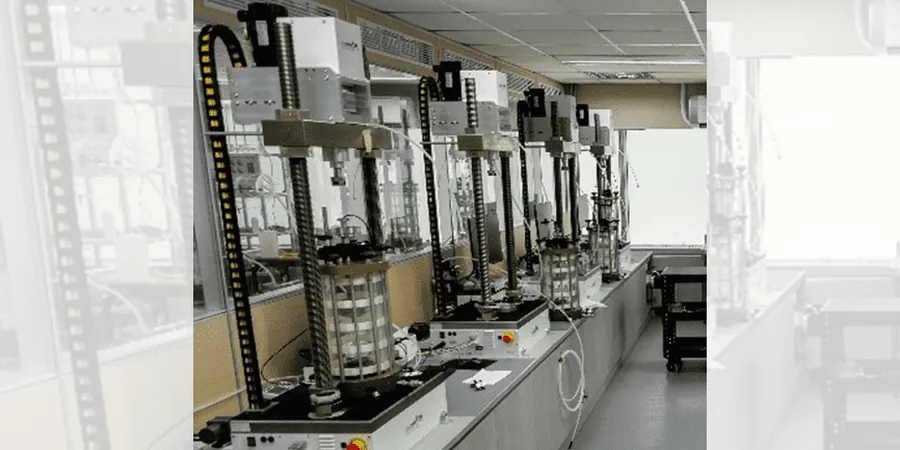
Our triaxial lab in Dundalk handles everything from single UU checks to full CD test suites with stress path plotting. We prepare samples in-house from your Shelby tubes or block samples—minimising disturbance is half the result.
CU Triaxial with Pore Pressure
Consolidated-undrained test with electronic pore pressure measurement. We deliver c' and φ' for effective stress analysis, plus undrained shear strength Su for short-term stability checks.
CD Triaxial for Drained Parameters
Consolidated-drained testing at slow strain rates, suited for free-draining granular soils and long-term settlement analysis in glacial sands common north of the town centre.
Multi-Stage Triaxial
Single specimen tested at increasing confining pressures. Reduces sample variability when material is limited—useful for stiff glacial till where Shelby recovery is patchy.
Frequently asked questions
What does a triaxial test in Dundalk typically cost?
A single UU test runs around €1.820, while a full CU or CD suite with pore pressure measurement ranges from €2.150 to €2.650 depending on specimen diameter and number of confining stages. Multi-stage tests fall in the middle. We quote per project, not per sample, so you get a clear figure before we start.
Which triaxial type suits Dundalk's glacial till?
For the stiff, overconsolidated till found across much of the town, consolidated-undrained (CU) tests with pore pressure measurement work best. They capture both peak strength and the dilatant behaviour typical of dense tills. If the till is fissured and drains quickly, a CD test may be more appropriate.
How do you handle soft alluvial clays from the Castletown River area?
We use thin-walled Shelby tubes to minimise disturbance, then run CU tests with back-pressure saturation. B-checks above 0.95 confirm full saturation. Strain rates are kept low—0.02 mm/min—to allow pore pressure equalisation across the specimen.
What sample quality do you need for reliable triaxial results?
Undisturbed samples are essential. We recommend Class 1 samples to EN 1997-2: thin-walled push tubes, properly sealed and transported upright. Disturbed or remoulded samples can only be used for reconstituted UU tests, which provide conservative Su values but not true effective stress parameters.
Can triaxial results be used directly in finite element models?
Yes. We export stress-strain data, pore pressure evolution, and failure envelopes in formats compatible with PLAXIS, Abaqus, and Wallap. For hardening soil models, we provide E50 and Eur from the deviatoric stress curves at each confining pressure.